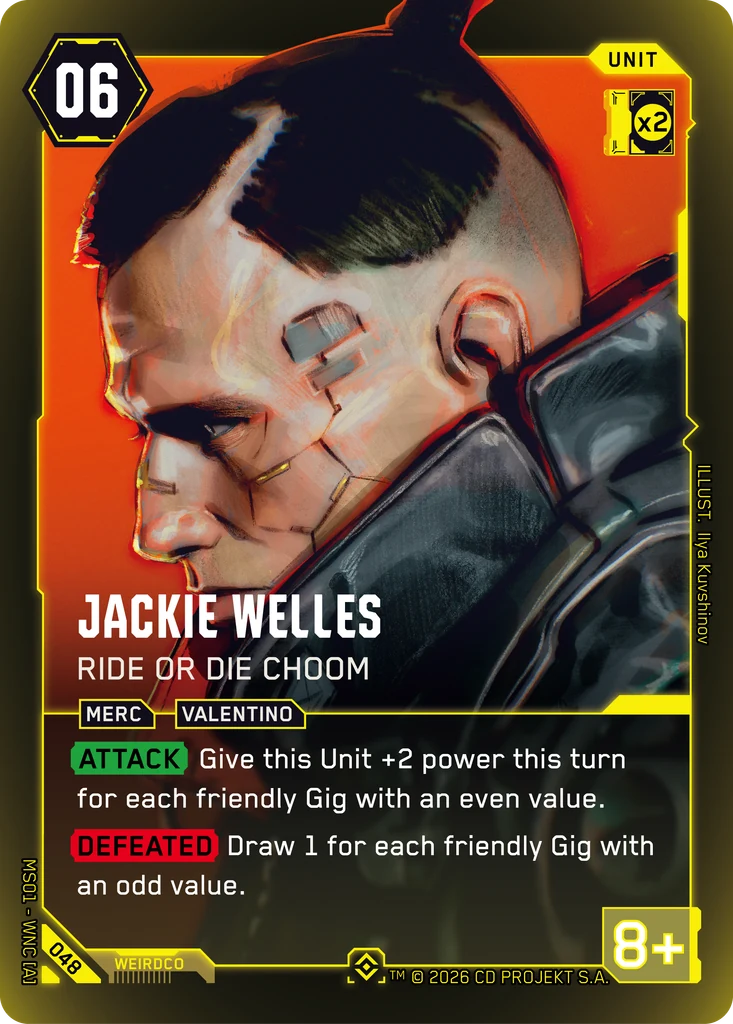

The debut set, Welcome to Night City, hits full retail on 6 November 2026 — but product reaches collectors well before that, and the gap matters more than the release date does.
The dates that actually matter
WeirdCo has published the full schedule. Four dates, in order:
- Around 1 September 2026 — Kickstarter backer fulfilment begins, with a roughly two-week delivery window depending on country. This is when the first sealed product physically exists in collectors' hands.
- 10–17 September 2026 — in-store Beta Events. Sealed deck, open to anyone, no backing required; the kit is bought at the store and contains Booster Packs and promos.
- Weekend of 30 October 2026 — Retail pre-release weekend.
- 6 November 2026 — full retail release.
The practical consequence: the singles market forms in September, roughly two months before retail. Anyone waiting for 6 November to start paying attention will be reading a market that has already had two months to set its own prices. That is the window where mispricing lives.
What nobody knows yet
There is no secondary market for these cards, because the cards are not out. Any site showing you card "prices" today is showing you preorder asking prices, placeholder data, or invention. There are no sales to average.
What is knowable: the card pool as revealed, the rarity distribution, and the historical behavior of comparable licensed TCG launches.
Sealed versus singles
Sealed product holds value when a set is genuinely scarce and stays desired. Singles reward you when a specific card becomes format-defining. Sealed is the lower-variance position and the slower one; singles are the opposite. Before a release with unknown print run, sealed is the more defensible bet purely because it does not require guessing which card matters.
The launch-window trap
Prices for a new set are almost always highest in the first fortnight, when supply is thinnest and attention is highest, then fall as product floods in. Buying singles at launch is buying at the least favourable point of the curve unless you need the card to play with.
What to actually track
- Print run signals — reprint announcements, distributor allocations, anything indicating how much product exists.
- Tournament results, once they exist. Competitive play is what turns a card from art into demand.
- Your own cost basis. A collection is only up if you know what you paid. CHOOMDEX tracks purchase price, date and source per holding.
CHOOMDEX pulls live eBay data for every cataloged collectible, and labels asking prices as asking prices — never as sales.